Trooday
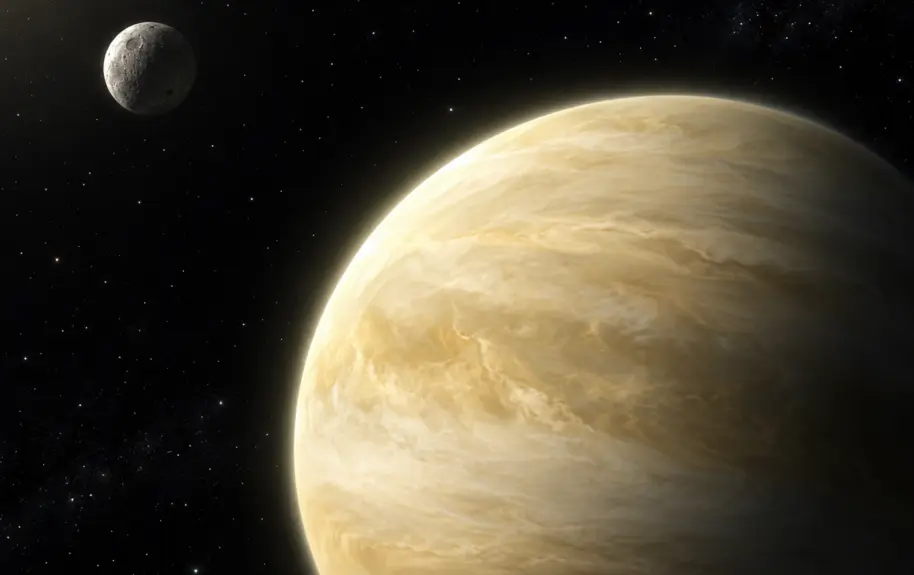
Conceptual illustration of Venus with a hypothetical rocky moon nearby.
Science & Space

Does the Venus moon study prove that the planet swallowed a moon?

Published

Verdict
False
Verification confidenceHigh

Explanation

No. The study does not prove that Venus once had a moon and swallowed it. It investigates whether a hypothetical moon could survive, rather than establishing that such a moon existed.

The researchers modelled interactions between Venus, a satellite and the Sun under different starting conditions. Some scenarios led to the moon's destruction, while others allowed survival. The results provide a possible explanation for Venus's lack of a moon, conditional on the model assumptions.

UC Riverside's September 14 announcement explicitly says that whether a moon ever formed remains an open question. A model showing how an event could happen is not evidence that it actually happened. The proposed history remains a hypothesis.

Key takeaway

The study offers a possible fate for a hypothetical Venusian moon. It does not confirm that Venus ever had or destroyed one.

Evidence

The research models a hypothetical satellite

Stephen R. Kane and colleagues

Contradicts the claim

The paper studies the evolution of an assumed Venusian moon across different starting conditions. It presents a conditional mechanism for moon loss rather than a detection or confirmation of a former moon.

Based on: arXiv

The university explicitly states that a former moon is unproven

University of California, Riverside

Contradicts the claim

The university's announcement says the finding does not prove that Venus once had a moon and that whether one ever formed remains an open question.

Based on: University of California, Riverside

Model outcomes depend on the initial conditions

Stephen R. Kane and colleagues

Provides context

The paper includes both survival and destruction scenarios. Its results depend on assumptions such as initial planetary rotation, satellite mass and the treatment of tidal interactions.

Based on: arXiv

Independent reporting describes the limits of observational evidence

Space.com

Provides context

In a direct interview, the lead researcher discusses the difficulty of finding physical traces of a lost moon and possible future avenues for testing the hypothesis.

Based on: Space.com

Was this check helpful?

Sign in required

Sign in required

How we check claims

Related checks

A bat resting in a natural roost with its eyes visible.
Science & Space

Are bats blind?

No. Bats have functional eyes and can see. Their visual abilities vary between species, so limited detail vision should not be confused with blindness.

Verdict
False
Verification confidenceHigh