Trooday
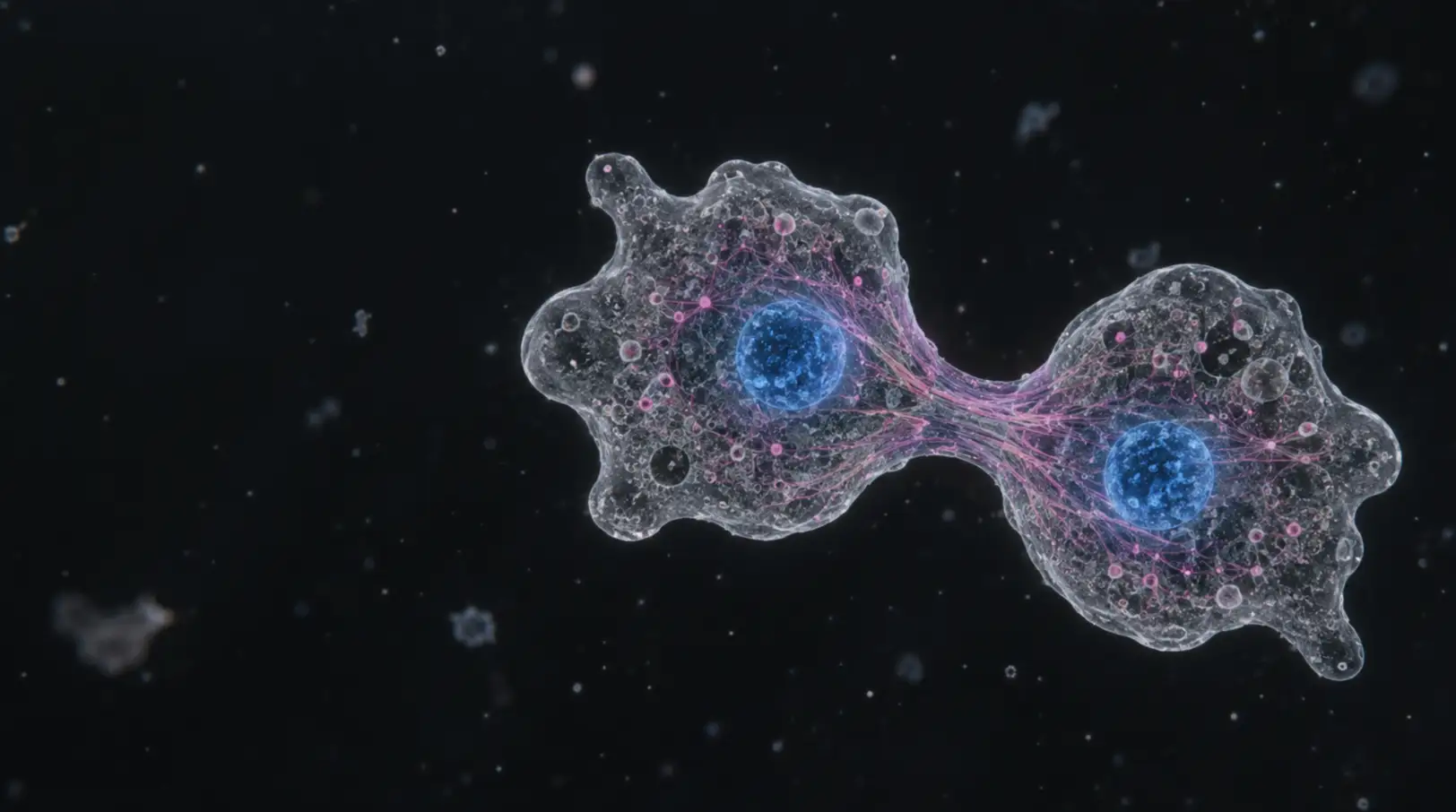
Microscope image of Incendiamoeba cascadensis undergoing cell division.
Science & Space

Can the "fire amoeba" reproduce at 63°C?

Published

Verdict
True
Verification confidenceMedium

Explanation

Yes. Researchers observed Incendiamoeba cascadensis, nicknamed the fire amoeba, reproducing by cell division at 63°C. It is a single-celled eukaryote, meaning its cell contains a nucleus.

The researchers' publicly accessible preprint abstract reports growth experiments and microscopy showing division at 63°C. Syracuse University's September 22, 2026 account of the study describes the same result. The central finding was already public in a November 2025 preprint; the recent coverage does not date the original observation.

Reproduction and survival are different measurements. NASA reports recovery after five minutes at 70°C, while Syracuse describes a dormant protective state at that temperature. Neither establishes reproduction at 70°C, and the organism's abilities should not be generalized to all eukaryotes.

Key takeaway

The reported reproduction temperature is 63°C. Surviving a brief, hotter exposure does not mean the amoeba can reproduce there.

Evidence

Growth experiments and microscopy show division at 63°C

H. Beryl Rappaport and colleagues

Supports the claim

The preprint abstract reports cellular proliferation in growth experiments and microscopy of mitosis. The accessible figure legends also describe replication at temperatures up to 63°C.

Based on: bioRxiv via PubMed

The research institution reports the same reproduction threshold

Syracuse University

Supports the claim

The university states that cultured amoebae continued dividing at 63°C. This account describes the same research and is not an independent replication.

Based on: Syracuse University

Recovery at 70°C is a separate survival result

NASA

Provides context

NASA describes recovery following five minutes of exposure to 70°C. That observation concerns survival and recovery rather than cell division at that temperature.

Based on: NASA

Was this check helpful?

Sign in required

Sign in required

How we check claims

Related checks

A bat resting in a natural roost with its eyes visible.
Science & Space

Are bats blind?

No. Bats have functional eyes and can see. Their visual abilities vary between species, so limited detail vision should not be confused with blindness.

Verdict
False
Verification confidenceHigh
Close-up of a faceted diamond with a small chip along its edge.
Science & Space

Are diamonds unbreakable?

No. Diamonds resist scratching extremely well, but a hard impact can chip or fracture them. Hardness and resistance to breaking are different properties.

Verdict
False
Verification confidenceHigh