Trooday
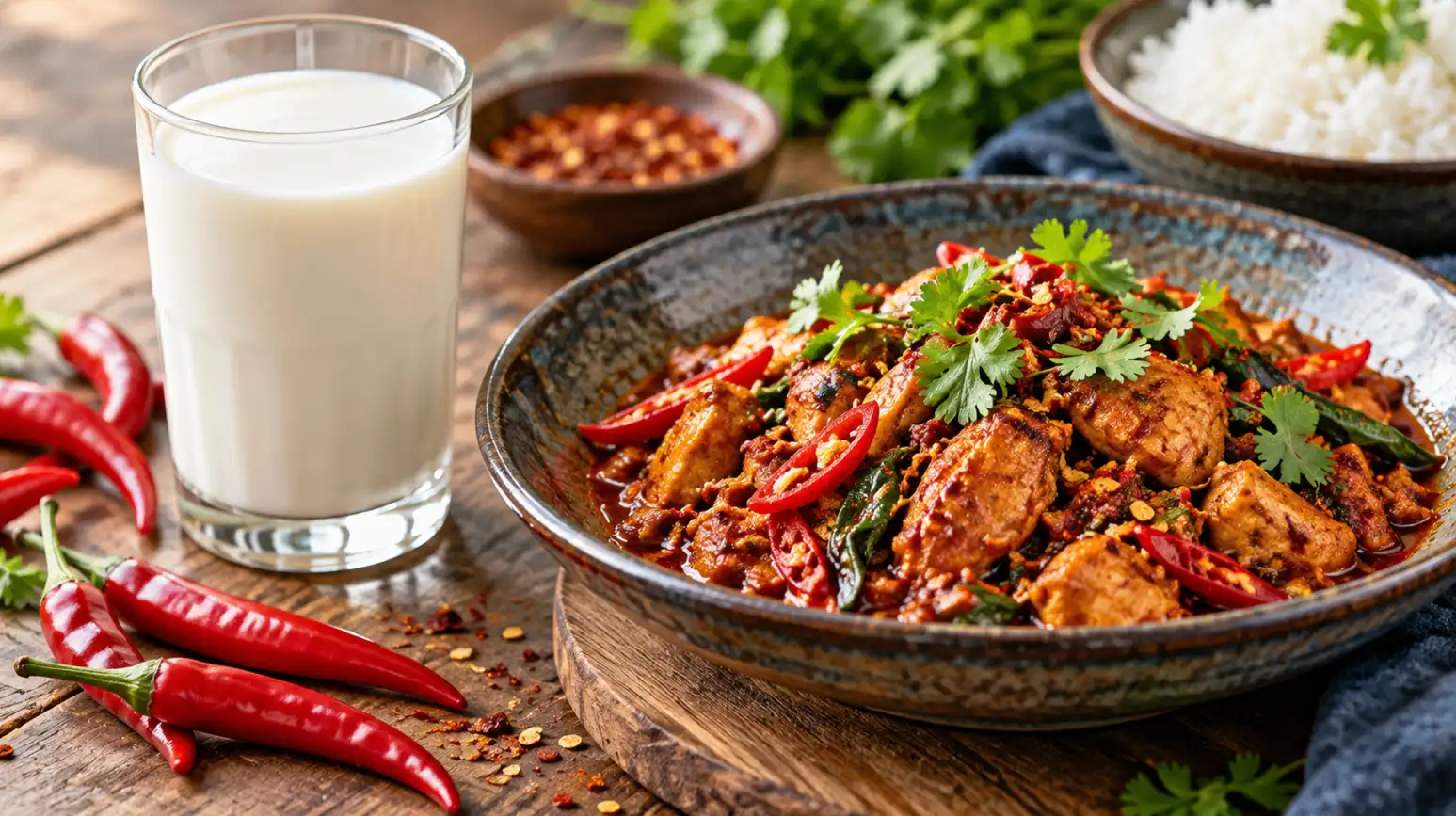
A glass of milk beside a chili-spiced dish and fresh red chili peppers.
Science & Space

Does milk help with spicy food?

Published

Verdict
True
Verification confidenceHigh

Explanation

Yes. Milk can reduce the oral burning sensation caused by capsaicin, the pungent compound in chili peppers. This is evidence about perceived mouth burn, not a claim that milk removes every effect of spicy food.

In a study of 72 adults, both skim and whole milk reduced the burn from spicy tomato juice more than room-temperature water. Whole milk did not significantly outperform skim milk. Later research indicates that serving temperature and food composition both contribute to burn reduction.

The mechanism is more complex than fat alone, and casein should not be described as a guaranteed antidote. An independent 24-person experiment found no robust overall difference between brief rinses with milk proteins, lactose and skim milk. Results depend on the exposure and testing conditions, and do not establish equivalent relief for every kind of spice.

Key takeaway

Milk can ease chili-induced mouth burn, and whole milk is not consistently more effective than skim milk.

Evidence

Skim and whole milk reduced chili burn

Nolden, Lenart and Hayes

Supports the claim

In 72 adults, both milk types reduced burning after spicy tomato juice more than room-temperature water. No significant difference was detected between skim and whole milk.

Based on: Physiology & Behavior — PubMed Central · Physiology & Behavior — Aarhus University repository

Independent testing limits simple protein explanations

Gøkhan, Sørensen and Baad-Hansen

Provides context

A 24-person crossover study found no robust overall difference between casein, whey, lactose and skim-milk rinses after capsaicin gel exposure. Exploratory casein effects were small and short-lived.

Based on: Journal of Food Science — Wiley · Physiology & Behavior — PubMed Central · Physiology & Behavior — Aarhus University repository

Temperature and composition both matter

Gaiser and Hayes

Provides context

Experiments comparing dairy and nondairy palate cleansers showed that cooling alone did not explain their different effects. The authors also cautioned that commercial products do not isolate individual ingredient mechanisms.

Based on: Journal of Food Science — Wiley

Was this check helpful?

Sign in required

Sign in required

How we check claims

Related checks