Trooday
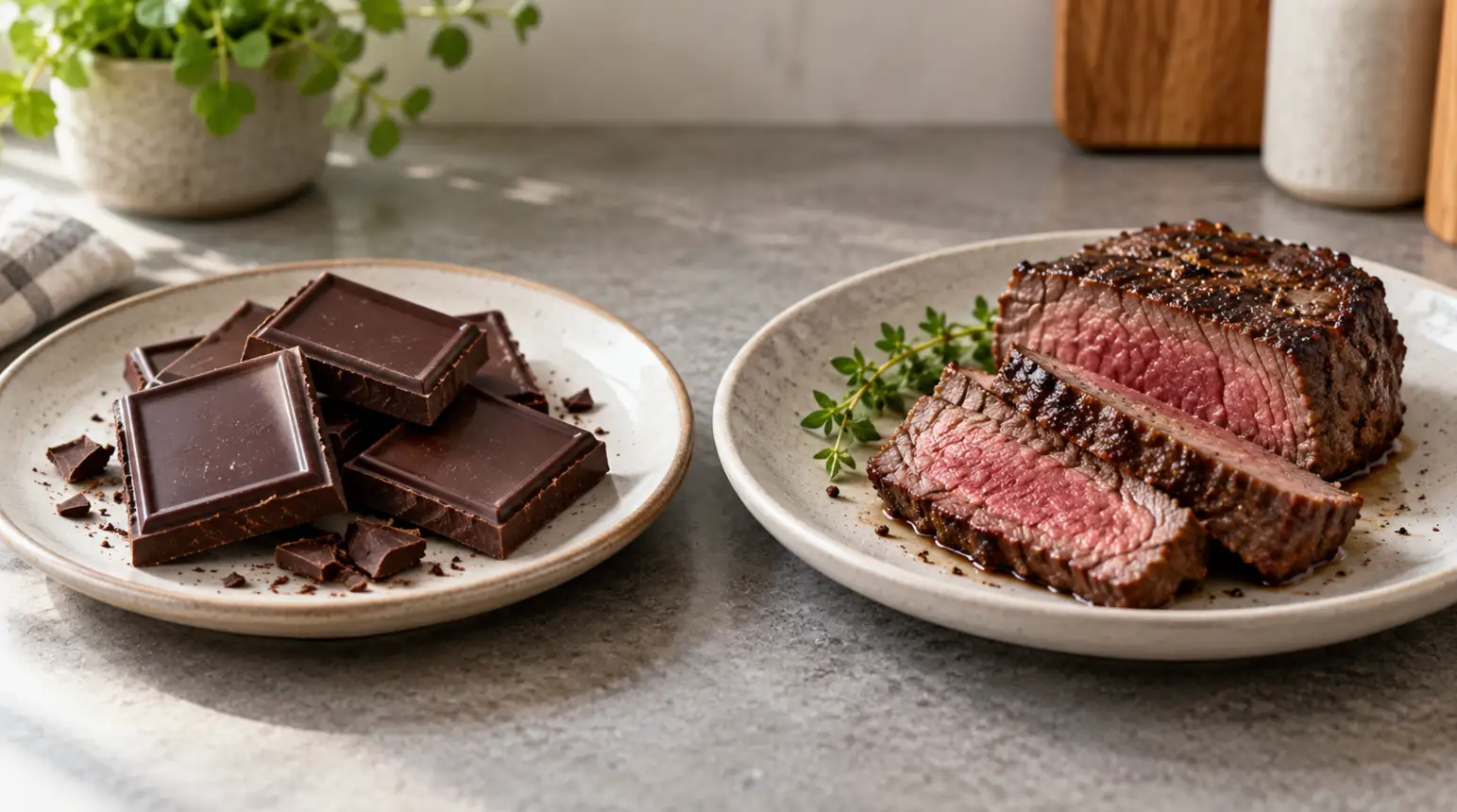
Pieces of dark chocolate and cooked beef arranged on separate plates.
Health

Does dark chocolate have more iron than beef?

Published

Verdict
True
Verification confidenceHigh

Explanation

Yes, when comparing equal weights of representative dark chocolate and beef. This is a comparison of iron concentration, not a rule that any chocolate portion contains more iron than any beef portion.

The NIH lists approximately 2 mg of iron in one ounce of dark chocolate containing 45–69% cacao solids, and approximately 2 mg in three ounces of braised bottom-round beef. These rounded figures show that the chocolate contains more iron per unit of weight. Harvard’s Nutrition Source independently identifies dark chocolate as a source of iron.

The amount absorbed is a separate question: beef contains heme iron, which is more readily absorbed than nonheme iron. Chocolate formulations, beef cuts and portion sizes also differ. The comparison does not establish that chocolate is nutritionally equivalent to beef or a better way to address iron deficiency.

Key takeaway

Dark chocolate can contain more iron by weight, but iron content and iron absorption are different measures.

Evidence

The listed chocolate has more iron per unit of weight

NIH Office of Dietary Supplements

Supports the claim

The table lists about 2 mg of iron per ounce of 45–69% cacao dark chocolate and per three ounces of braised bottom-round beef. Comparing their listed weights supports the concentration claim.

Based on: NIH Office of Dietary Supplements

Iron content does not determine absorption

NIH Office of Dietary Supplements

Provides context

Heme iron has greater bioavailability than nonheme iron, so a comparison of total iron does not establish how much the body absorbs.

Based on: NIH Office of Dietary Supplements

Independent nutrition reference identifies iron in dark chocolate

Harvard T.H. Chan School of Public Health

Provides context

Harvard lists dark chocolate as an iron source and describes variations in cocoa content and formulation. It does not provide a direct numerical comparison with beef.

Based on: Harvard T.H. Chan School of Public Health

Was this check helpful?

Sign in required

Sign in required

How we check claims

Related checks

Close-up of a blue iris and pupil illuminated by soft natural light.
Health

Are blue eyes more sensitive to light?

Some ophthalmologists link lighter eyes to light sensitivity, but experimental findings are inconsistent. Eye color alone is not a reliable predictor.

Verdict
Unverified
Verification confidenceMedium