Trooday
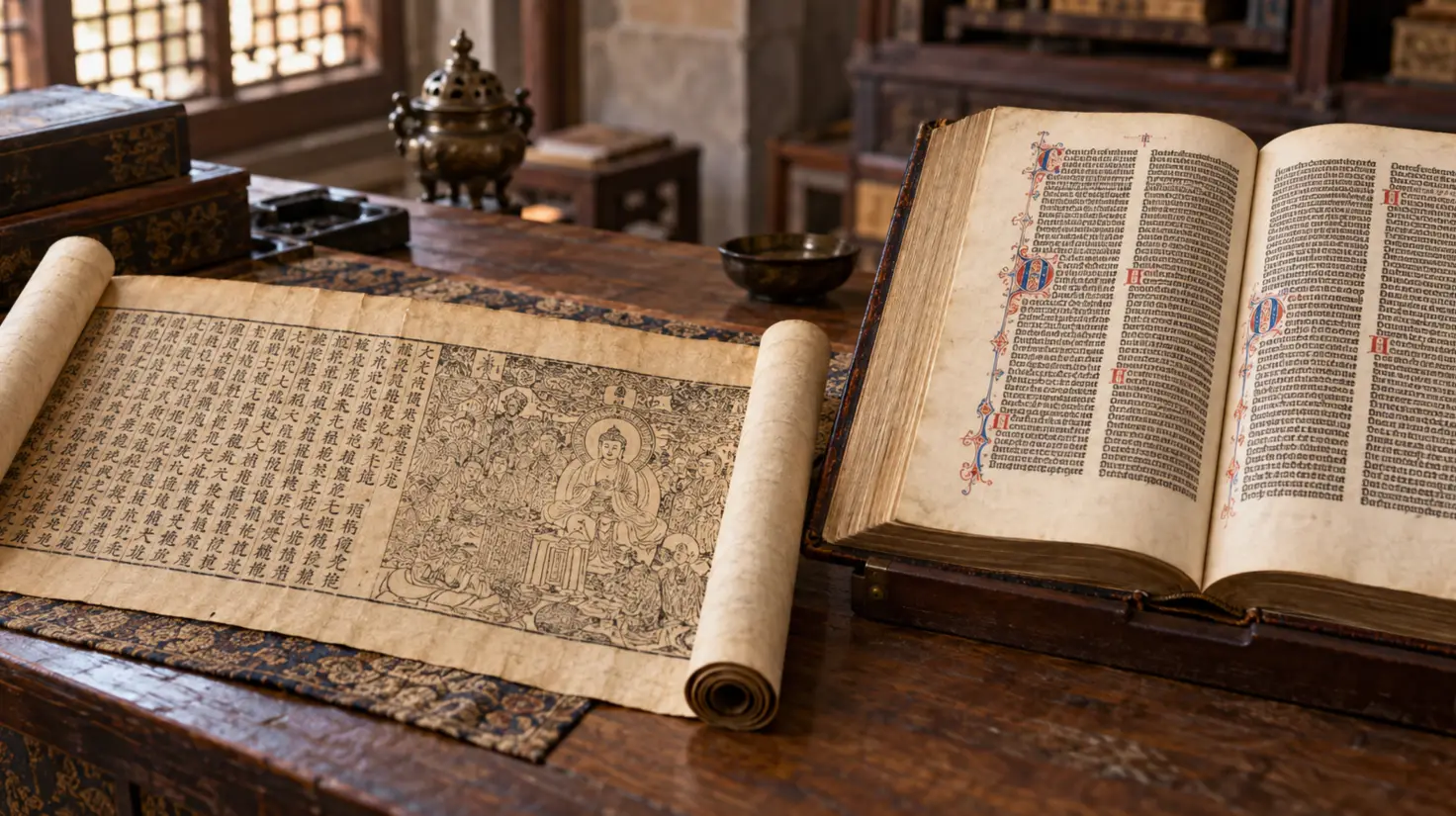
A Chinese-style printed scroll beside an open early European printed book in an illustrative historical comparison.
History & Facts

Was the Gutenberg Bible the world's first printed book?

Published

Verdict
False
Verification confidenceHigh

Explanation

No. The Gutenberg Bible, produced in Mainz in the mid-1450s, was not the world's first printed book. A surviving Chinese printed copy of the Diamond Sutra bears a date corresponding to 11 May 868.

The British Library's International Dunhuang Programme describes that scroll as woodblock printing on seven joined sheets of paper. The Library of Congress identifies Gutenberg's Bible more specifically as the first great book printed in Western Europe from movable metal type.

These are different printing methods and different historical milestones. The Diamond Sutra provides a documented earlier example; its status as the earliest dated printed book does not establish that printing itself began in 868.

Key takeaway

Gutenberg's Bible marks a major European printing milestone, not the beginning of printed books worldwide.

Evidence

A surviving printed scroll is dated 868

British Library — International Dunhuang Programme

Contradicts the claim

The collection interpretation identifies the Diamond Sutra as a woodblock-printed Chinese scroll. Its colophon dates the sponsorship of this copy to 11 May 868, centuries before Gutenberg's Bible.

Based on: British Library — International Dunhuang Programme

Gutenberg's milestone is specifically European and typographic

Library of Congress

Provides context

The Library of Congress describes the Gutenberg Bible as the first great book printed in Western Europe from movable metal type and places its probable completion in late 1455.

Based on: Library of Congress

The two documented objects establish the chronology

British Library and Library of Congress

Contradicts the claim

The institutions' descriptions establish that the printed Diamond Sutra of 868 existed centuries before the Gutenberg Bible of the mid-1450s. This directly contradicts the worldwide-first claim.

Based on: British Library — International Dunhuang Programme

Was this check helpful?

Sign in required

Sign in required

How we check claims

Related checks