Trooday
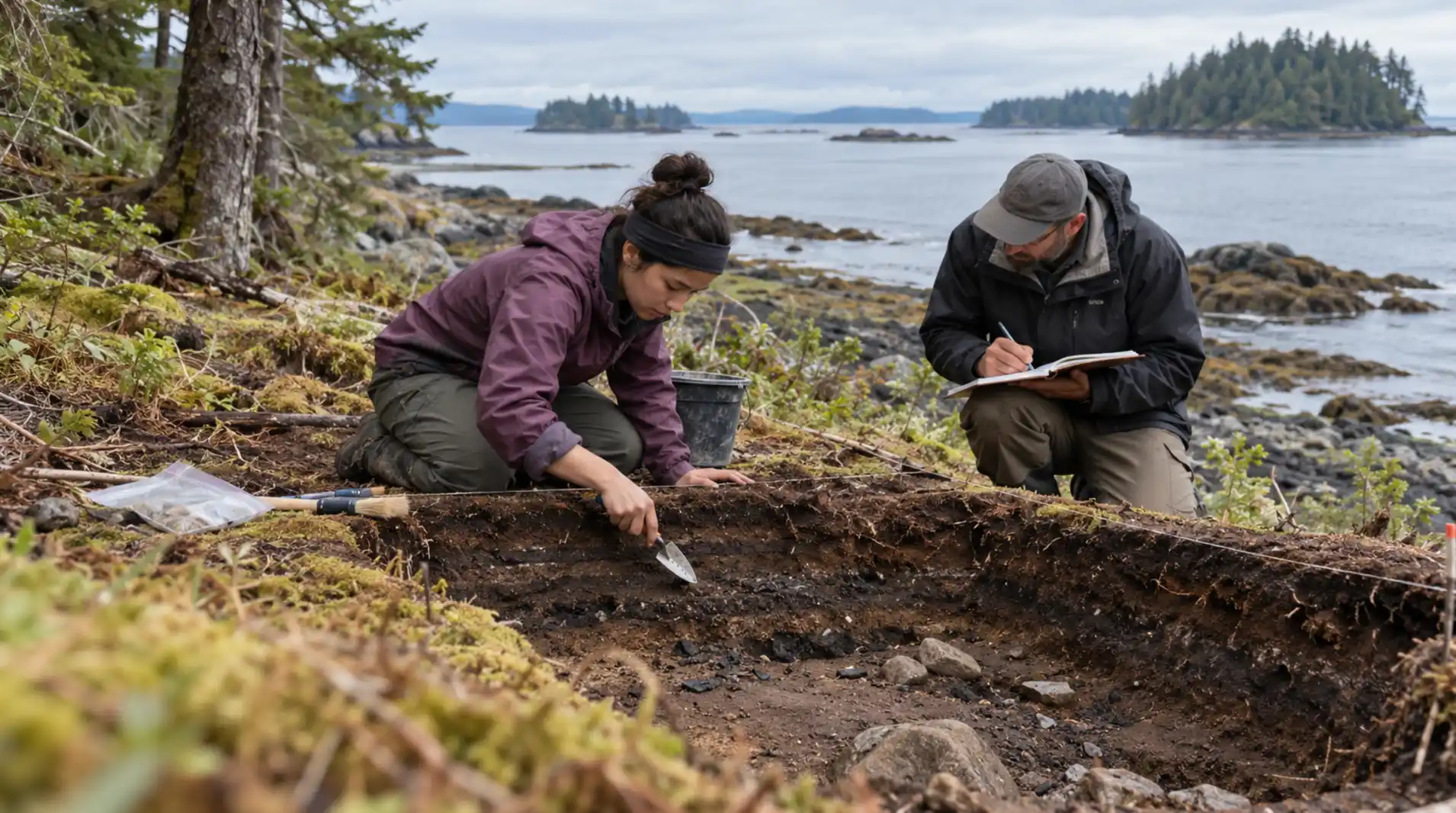
Archaeologist Alisha Gauvreau records notes during excavation at Triquet Island.
History & Facts

Was an Indigenous settlement in Canada found to be 11,000 years older than Egypt’s pyramids?

Published

Verdict
Misleading
Verification confidenceMedium

Explanation

The discovery has a real basis, but the 11,000-year comparison is misleading. Triquet Island, in British Columbia’s Heiltsuk territory, has evidence of occupation dating back about 14,000 years. That puts it roughly 9,500 years before the Great Pyramid, rather than 11,000.

Hakai Institute reports radiocarbon dates of approximately 13,748–14,802 years ago for charcoal from an ancient fireplace. Egypt’s antiquities ministry places Khufu, whose tomb is the Great Pyramid, around 2589–2566 BCE. Egypt’s earlier Step Pyramid dates to Djoser’s reign, around 2667–2648 BCE. These chronologies do not produce an 11,000-year gap.

Another possible reference is Âsowanânihk in Saskatchewan, reported as approximately 11,000 years old. That is its age, not how much it predates the pyramids; the difference would be roughly 6,400 years. The original post was not supplied, so the intended site remains uncertain, and archaeological dates should be treated as estimates.

Key takeaway

These Canadian sites are older than Egypt’s pyramids, but their reported ages do not support an 11,000-year difference.

Evidence

A genuine ancient settlement at Triquet Island

University of Victoria; Smithsonian Magazine

Supports the claim

Both describe an approximately 14,000-year-old settlement. This supports the discovery component, not the claimed age difference.

Based on: University of Victoria · Smithsonian Magazine

The dated evidence does not produce an 11,000-year gap

Hakai Institute; Egyptian Ministry of Tourism and Antiquities

Contradicts the claim

Comparing the reported charcoal dates with the chronology of Khufu’s pyramid yields approximately 9,000–10,300 years, allowing for dating conventions and rounding.

Based on: Hakai Institute · Egyptian Ministry of Tourism and Antiquities

Using Egypt’s first pyramid does not resolve the discrepancy

Egyptian Ministry of Tourism and Antiquities; Hakai Institute

Contradicts the claim

Djoser’s pyramid is earlier than Khufu’s, making the difference slightly smaller.

Based on: Egyptian Ministry of Tourism and Antiquities · Hakai Institute

Another Canadian discovery is described as 11,000 years old

saskNOW / EFN Media

Provides context

Âsowanânihk is a distinct Saskatchewan site. Its reported age may explain a confusion, but no connection to the original wording has been established.

Based on: saskNOW · Smithsonian Magazine

Was this check helpful?

Sign in required

Sign in required

How we check claims

Related checks